Open Source · Kander
Kander: a kanban board for coordinating AI coding agents
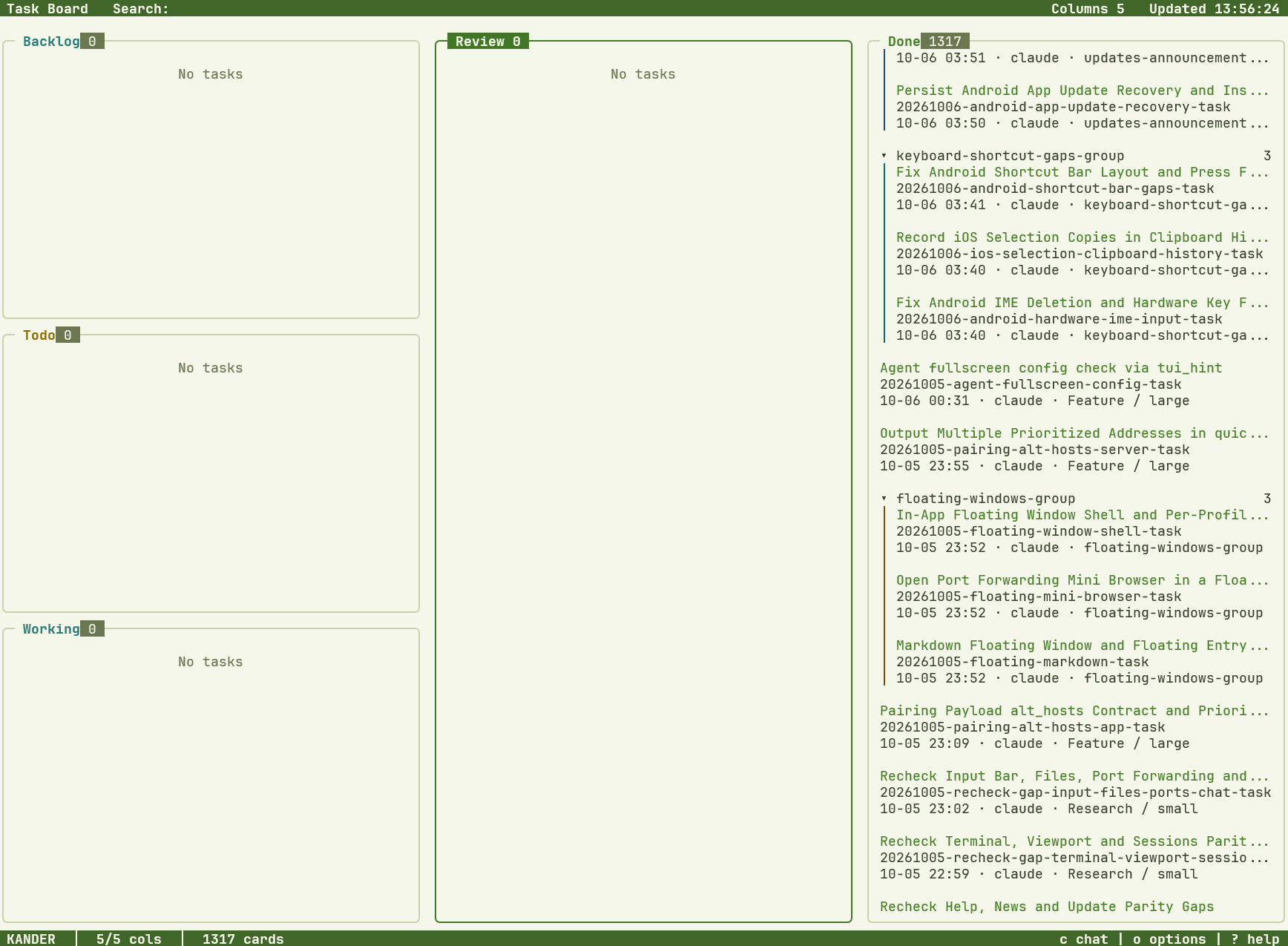
Kander runs several coding agents in parallel under strict rules. Each task gets its own git worktree and terminal, and an independent reviewer checks the work before it is delivered. It is open source under the MIT license.
The problem it solves
Once coding agents can implement real features, the hard part moves from generating code to coordinating and checking the work. Several agents in one repository can overwrite each other, and an agent that reviews its own work can miss its own mistakes. Kander adds the structure a team would use: task cards, isolated workspaces, separate reviewers and a gate before delivery.
Key features
- Independent review gates
- Execution and review run separately. A PMQA stage checks the task contract and looks for semantic and state-machine bugs; a Security stage runs when the change calls for it.
- Conflict-aware scheduling
- Kander checks Git branch overlap and file boundaries, so parallel work stays controlled.
- Isolated workspaces
- Each task runs in its own git worktree, in a tmux window or a Herdr tab.
- GitHub integration without a token
- Browse issues and import them as task cards from the board. Kander reuses the credentials the
ghCLI already manages; it never asks for, reads or stores a token. - Terminal board
- Run
kanderto see every card, press/to filter,gto open GitHub issues andcto open a chat session without creating a card.
Production numbers
Kander comes from real engineering work. These figures run to 2026-10-29 and come from Kander's production stats, which also give the definitions and scripts to reproduce them.
| Measure | Result |
|---|---|
| Team | One developer and 6 agents over 90 days |
| Task cards done | 2,477 across 5 projects, 1,980 of them on QuickTUI |
| Independent review runs | 2,865 |
| Review batches that found must-fix issues | 773 of 1,504 (51%) |
| Median time per card | 57 minutes |
Card counts measure throughput, not value or difficulty. Task sizes differ between projects.
Install Kander
Kander needs Git and at least one of Codex, Claude, Grok, Cursor or Pi.
# macOS
brew install dualface/tap/kander
kander

# Linux
ARCH=$(uname -m); [ "$ARCH" = x86_64 ] && ARCH=amd64; [ "$ARCH" = aarch64 ] && ARCH=arm64
curl -fsSL "https://github.com/dualface/kander/releases/latest/download/kander-linux-${ARCH}.tar.gz" | tar xz
./kander
On Windows, download kander-windows-amd64.zip from Releases, unzip it and run kander.exe. The first launch starts an interactive setup wizard.
How you work with it
- Start an agent session and discuss the task until the goal and acceptance criteria are clear.
- Confirm the task. With Kander's rules loaded, the agent creates the card and starts it.
- Repeat for each requirement, so several cards run at once.
- Run
kanderto check the status of every card.
Use Kander from your phone
Kander keeps agents working in terminals on your computer, so you can follow them when you are away from it. QuickTUI opens those tmux and Herdr sessions on iPhone, iPad and Android. See Run Kander from your phone.
Documentation
- README
- Installation, board shortcuts and common questions, in English, Chinese and Japanese.
- Kander in Production
- How real failures shaped the workflow.
- Review Disposition
- How review findings are handled before a card can finish.
- Card Transactions
- How the board recovers after a crash.
- Terminal Backends
- How Kander drives tmux, Herdr and other terminals.
- Why I use a cheaper model for code review
- An article on model choice, with data from more than 2,000 Kander tasks.
FAQ
Is Kander free?
Yes. Kander is open source under the MIT license. You still pay for the agents you run through it.
Which agents does it work with?
Kander needs at least one of Codex, Claude, Grok, Cursor or Pi. Different agents can execute and review, so one agent's work can go to another for review.
Which operating systems does it support?
macOS, Linux and Windows. On Windows, the terminal container is Herdr; tmux is not supported there.
Do I need QuickTUI to use Kander?
No. Kander works on its own. QuickTUI adds access from your phone.