Use case · AI agents
Control AI agents from your phone
AI agents do their best work when someone is watching: kicking them off, approving the risky steps, and nudging them back on track. QuickTUI puts that control in your pocket: start an agent on your own machine, then supervise and steer it from your phone over a real terminal.
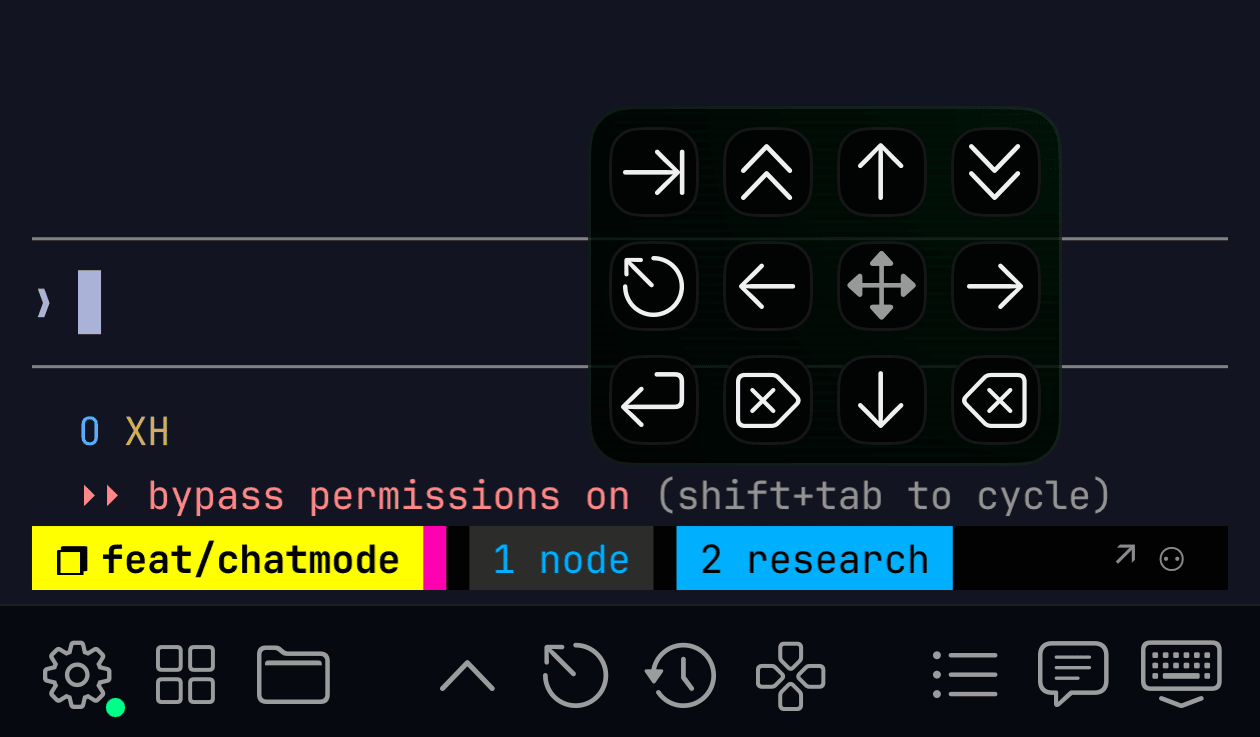
Agents like Claude Code and Codex run in a terminal and work over minutes, so the useful question is not "can I chat with it" but "can I keep it running and keep it honest from anywhere." QuickTUI is a native iPhone and iPad app (plus a browser client) that attaches to real tmux on a machine you host, so the agent stays alive on the machine while you drive it from the phone.
Kick off and supervise
- Start a run. Open a session, launch the agent, and hand it a task, the same prompt you would type at your desk.
- Approve and steer. Watch the live output, approve tool calls, answer questions, and redirect the agent when it drifts. You see the real terminal, not a summary.
- Act as a session keeper. Step away and the run continues in tmux on the machine. Reopen the app and the session keeper reattaches to the live view across Wi-Fi to LTE or 5G, app backgrounding, and dropped connections.
Choose when Agent notifications reach you
Agent notifications are optional and stay off on a device until you grant notification permission and enable that device's registration. Each server separately controls the approval request, task complete, error, and session ended categories sent to registered devices. The default notification text only names the event; separate field switches can add the Agent type, project name, session name, and a task or error summary.
Delivery uses QuickTUI Relay and APNs or FCM, even when your normal terminal connection is direct. Route-only identifiers needed to deliver, deduplicate, and open the matching local profile/session/interaction are independent of the text switches. See the Privacy Policy for the data flow, retention boundary, and revocation controls.
Set up your machine
Install QuickTUI on the machine where your agents should run. It sets up the service. On macOS/Linux install tmux 3.2+ yourself first (the installer does not install tmux). On Windows it installs the qscn session backend automatically.
macOS / Linux
curl -fsSL https://quicktui.ai/q.sh | shWindows (PowerShell)
irm https://quicktui.ai/q.ps1 | iexWindows note: the session backend is qscn, not tmux. Create sessions with New Session in the app; the tmux new-session examples below apply to macOS/Linux.
Pair the app with the platform commands below. The QR registers this device and pins the server identity; there is no root token to enter.
# macOS / Linux
quicktui-server pairing qrcode

# Windows (PowerShell)
& "$env:LOCALAPPDATA\QuickTUI\quicktui-server.exe" pairing qrcode
The connection is direct by default, so your code and keys never touch our servers.
Works with any agent
Because QuickTUI drives real tmux, it is not tied to one tool. Run Claude Code, Codex, or any CLI agent, each in its own session, and switch between them from the phone.
tmux new-session -s agent
claude # or: codex, or any CLI agentFAQ
Which agents can I control?
Any CLI agent that runs in a terminal: Claude Code, Codex, or your own tools. QuickTUI drives real tmux, so it is not limited to a specific product.
Can I approve steps and steer the agent, not just read output?
Yes. You get the live terminal, so you can answer prompts, approve tool calls, and redirect the agent in real time from your phone.
Does the agent keep running while I am away?
Yes. It runs in tmux on your machine and continues after you detach. The session keeper reattaches to the live session across network changes, app restarts, and dropped connections.
Are Agent notifications required?
No. The system permission and device registration are separate opt-in controls. Each server also has server-wide notification preferences. You can revoke permission, disable the device registration, or disable server categories at any time.